"Ingestion is not simply moving data — it is ensuring that every new byte counts and does not break what already supports decisions."
Why incremental ingestion is critical for modern analytics platforms
In today’s analytics environments, the trend is not to reload everything: it is to capture only the relevant delta. Incremental ingestion reduces latency, lowers compute costs and decreases the risk of introducing inconsistencies into processed tables. In the context of Microsoft Fabric, where Lakehouses, Dataflows and Spark pipelines coexist, a well-defined incremental strategy turns a problematic data channel into a predictable and auditable stream.

When we talk about near-real-time business decisions — for example, detecting fraud, feeding operational dashboards or inventory updates — the difference between a full load process and an incremental one can translate into minutes of delay and tens of thousands of euros in unnecessary processing. To quantify: a nightly full load of 1 TB can require a compute instance equivalent to 32 vCPU and 256 GB RAM for 3–4 hours, generating processing costs on the order of €800–€1,500 per run. In contrast, an incremental pipeline that processes only 20–50 GB per day reduces that requirement to smaller instances (8 vCPU / 64 GB) and execution windows of a few minutes, resulting in a much lower daily bill — often below €100 per day for similar workloads.
Beyond the economic side, there is an operational advantage: incremental pipelines allow fine-grained impact limits when something goes wrong. If a full load corrupts a table, reprocessing is heavy and time-consuming. With incremental, we can reprocess only the affected batches, reducing MTTR (Mean Time to Recovery) and the risk of prolonged maintenance windows.
Fundamental principles: idempotency, traceability and window bounds
Three principles underpin any effective incremental ingestion solution. First, idempotency: applying the same load twice cannot change the final result. This requires natural keys or deduplication techniques during ingestion (merge by key and timestamp, or row hashes). In practice, when designing a target table, include a composite natural key (e.g. order_id + line_item_id) and an ingestion timestamp. For cases without natural keys, use an identifier generated by the source or a hash combining critical fields.
Second, traceability: each incremental batch must be identifiable with metadata — for example, batch number, time range, source and state (pending, in progress, succeeded, failed). Those metadata allow selective reprocessing and audits. A typical control table should have columns: batch_id (UUID), source_system, start_time, end_time, record_count, bytes, status, error_message and processed_at. Having structured logs with these fields enables quickly gathering statistics and drawing timelines in case of incidents.
Finally, window bounds — choose the increment granularity (minutes, hours, days) according to the consumer SLA and acceptable cost. Short windows (for example, 5–15 minutes) are suitable for operational dashboards with low freshness SLAs, but increase orchestration overhead. Hourly windows balance freshness and cost; daily windows may be acceptable for strategic reports. A practical rule: set the initial window based on the most demanding consumer freshness requirement and then optimize granularity according to actual delta behavior and observed cost.
Practical patterns in Microsoft Fabric: CDC, watermarking and checkpoints
In Fabric, there are several ways to capture delta: Change Data Capture (CDC) from transactional databases, log reads, or timestamp-based comparisons. CDC is the pattern when the source supports and emits change logs; it is efficient and reduces transfers. For example, enabling CDC in a SQL Server database can reduce transferred volume from 1 TB of data to 20–50 GB of changes per day, depending on the business.
When CDC is not available, the combination of watermarking (last processed timestamp) and window filters is the pragmatic alternative. A typical watermark stores the largest timestamp value already processed per source-partition (e.g. store_id). When reading new files or tables, use WHERE modified_at > watermark. Keep in mind unsynchronized clocks: apply tolerances (lateness) of 1–5 minutes or even several hours, depending on the SLA and the late-arrival behavior of events.
Checkpoints — stored in a catalog or a control table in the Lakehouse — keep the progress point of each pipeline. In Spark pipelines within Fabric, using checkpoints and write-ahead logs (when applicable) ensures restarts resume from the correct point. For Dataflows and Pipelines, recording metadata in a control schema is essential for cross-team visibility. A practical example: create a table checkpoints(batch_id, source, partition_key, last_processed_timestamp, status, attempts), and update it atomically at the end of each batch. This allows detecting failure patterns (e.g., a store_id that consistently fails), and configuring automatic alert escalation.
Recommended architecture: components and flow in practice
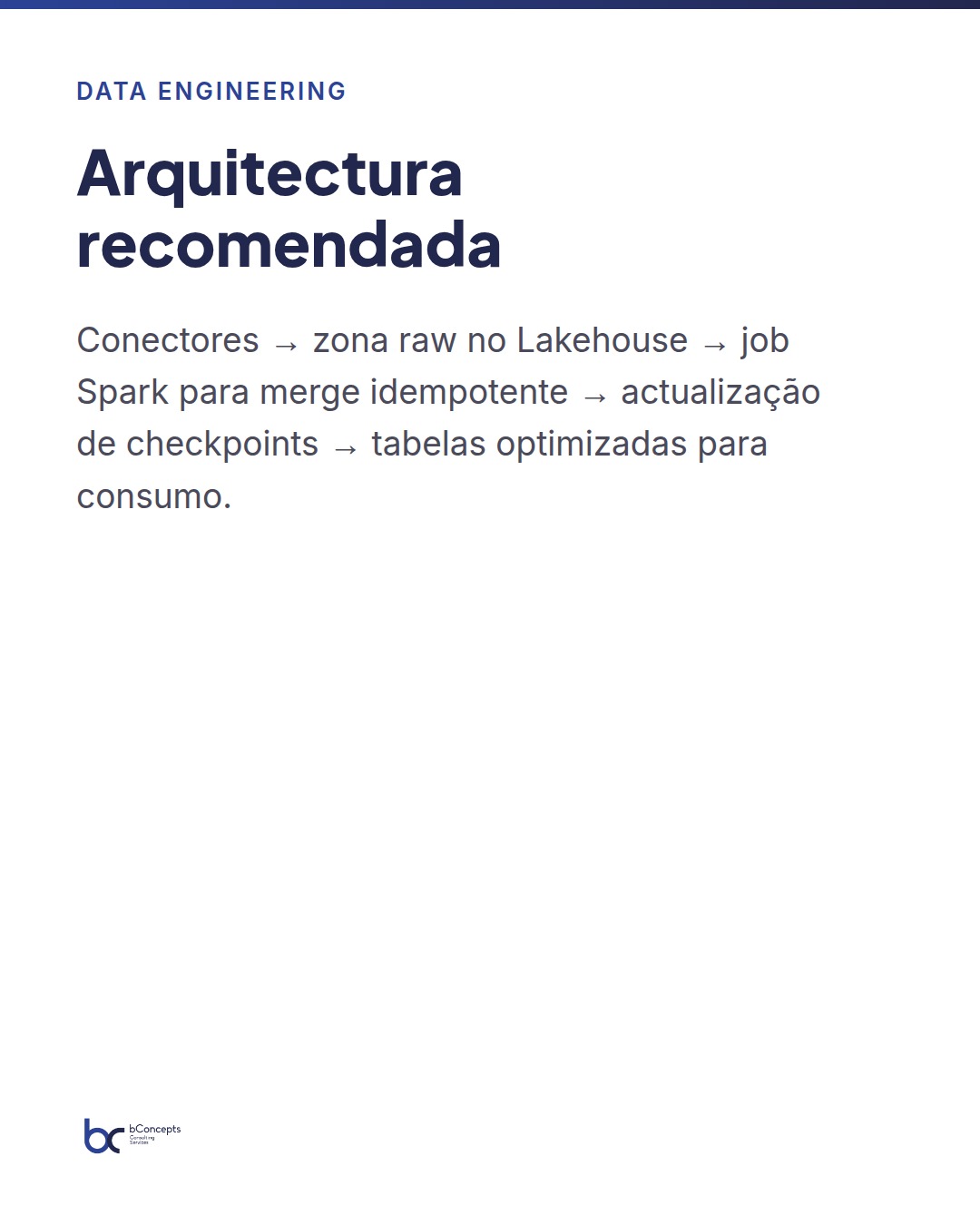
A robust incremental ingestion architecture in Fabric can include: source connectors (API, transactional database, files), landing zone in the Lakehouse (raw), control table for checkpoints, Spark job for incremental transformation and deduplication, and consumed tables in parquet/Delta format optimized for consumption by Power BI or analytical models.
The typical flow: 1) the connector captures delta based on the last checkpoint, 2) data is written to the raw zone with batch metadata, 3) a Spark job performs an idempotent merge into the integration table, 4) update the checkpoint and log the result. All this monitored by ingestion metrics (time per batch, record volume, error rate).
More operational details: implement a dispatcher that groups changes by logical partition (for example, by store, by client_id or by date). If the number of partitions is high — say 10,000 stores — process in parallel by groups of N partitions per job to avoid small files overhead and excessive concurrency on Delta Lake. A recommended pattern is to limit concurrency to 50–200 concurrent tasks, tuned based on Lakehouse IO behavior and acceptable costs.
Deduplication and merge strategies: options and trade-offs
To guarantee idempotency it is common to use MERGE (UPSERT) operations supported by Delta Lake. This solves most scenarios but has costs: merges on very large tables are expensive. Alternatives include keeping a staging table with only modified records and then applying a smaller merge, or using partitions that limit the affected area (for example, by day or by customer).
Another technique is deduplication by row hash: generate a hash from the columns that define uniqueness and compare with the previous version. If the hash changed, update. This method reduces IO, but requires managing theoretical collisions and ensuring all relevant fields are included in the hash. For example, generating a SHA-256 of concat(col1, col2, col3) produces a compact footprint; comparing that hash against the last version avoids full reads of large rows. In practical tests, this approach reduced IO by 40–70% for datasets where only 5–10% of records changed daily.
Additional trade-offs: MERGE provides atomicity and simplicity, but may require subsequent compaction operations (OPTIMIZE) to avoid fragmentation. Hash + apply logic reduces read cost, but complicates auditing and forensic analysis. Choose based on change profile and audit requirements: if it is necessary to prove exactly what changes occurred, prefer MERGE with logs; if the goal is pure efficiency, combine hashes with a small change log.
Mini practical case: reducing costs and latency for a national retailer
In a retailer with 80 stores and an e-commerce platform, the BI department struggled with daily full loads of 1 TB of transactional data to recalculate stock and aggregated sales. Refresh of critical reports in Power BI took 4 hours and consumed about €1,200 per run in Fabric compute costs.
We adopted incremental ingestion with these measures: 1) enable CDC on the transactional database (reduced volume to ~30 GB/day), 2) implement checkpoints by store and by day, 3) use merges partitioned by date and store, 4) deduplication by hash and retention of change logs for 30 days for audit. Result: processed volume fell from 1 TB to 30 GB/day (97% reduction), dataset refresh time dropped from 4 hours to 25 minutes, and cost per run was reduced to ~€75. This allowed the operations team to have near-real-time reports and freed budget for new analytics projects.
Beyond the financial numbers, there were qualitative gains: the number of data-related incidents decreased by 60% over three months thanks to improved batch traceability; the average investigation time for a discrepancy fell from 6 hours to 1.2 hours because it was possible to reprocess only the store and day in question. In terms of ROI, the initial engineering investment (around 3 weeks of work by two people) was amortized in less than a month given the reduction in operating costs.
Metrics to monitor and essential alerts
To keep incremental ingestion healthy, monitor: time per batch (latency), record volume processed, rejection rate (parsing, validation errors), merge time and lag between the source and the last checkpoint. These four indicators translate directly into SLAs for data consumers.
Alerts to configure: batch failure (immediate notification), sudden increase in delta volume (may indicate source error), repeated merge failures (can corrupt the integration table) and delays that exceed the defined SLA (for example, if the goal is 30 minutes freshness, alert at 20 minutes of lag). In Fabric, integrating these metrics with the monitoring dashboard and a ticketing system reduces MTTR (mean time to recovery).
Practical alert values: if average time per batch is 5 minutes, alert when it exceeds 15 minutes; if rejection rate exceeds 0.5% on a critical source, raise an alert; if lag increases 2× above the historical rolling-hour average, scale investigations. Combine technical alerts with business alerts (e.g. discrepancy greater than 1% between the sum of sales at source and destination) to catch issues that may not be visible from the technical side alone.
"Incremental ingestion is not a technical luxury: it is the foundation for faster, more predictable and economical decisions."
Operational common sense: rollback, retention and reprocesses
Even with checkpoints, situations will arise that require rollback or full reprocessing: source data corruption, retroactive corrections or schema changes. Have clear policies: raw retention windows (e.g.: 30-90 days), idempotent reprocessing scripts and reconciliation tests between source and destination.
Also plan for granular recovery: being able to reprocess only X days or a single store reduces impact. Document procedures and automate them as much as possible; a playbook that invokes parameterized jobs (start_date, end_date, store_id) speeds response and limits human error. Example: a parameterized script that reruns the pipeline for store_id=23 and start_date=2026-08-01 end_date=2026-08-02 typically takes 15–30 minutes to complete in an optimized environment, versus hours of full-table reprocessing.
Finally, include automated regression tests in the pipeline: every code change that performs merges or deduplication should be validated against a set of representative fixtures. This reduces the risk of introducing regressions that only surface after weeks of ingestion.
In summary
- Idempotency, traceability and window bounds are fundamental for sustainable incremental ingestion.
- In Microsoft Fabric, use CDC when available, combined with checkpoints and partitioned merges for efficiency.
- Monitor latency, volume, errors and lag; configure actionable alerts to reduce MTTR.
- Implement deduplication by merge or hash and maintain clear retention and reprocessing policies.
- Small optimizations in ingestion can reduce costs by 90%+ and transform analytical SLAs.
Conclusion: incremental ingestion in Microsoft Fabric is a combination of good technical practices and operational decisions. Start by mapping the source capabilities (does it support CDC?), define ingestion granularity and implement checkpoints from day one. Incremental transformation and idempotent deduplication pay off quickly in lower costs and reduced latencies — results that users and managers notice immediately.
Next practical step: choose a pilot pipeline (a source with high volume and clear consumers), implement checkpoints and metrics in 2 weeks and measure the impact in the first month. Which source in your organization would make the most sense to test first?