Privacy is not an extra: it is the requirement that turns models into safe business assets.
Why privacy matters in enterprise ML
In our client implementations, privacy ceases to be just a legal requirement and becomes a determining factor for adoption. A model that leaks sensitive information compromises revenue, reputation and, in severe cases, triggers fines and loss of trust from partners and customers. Companies that process personal, transactional or health data need to ensure models do not allow re‑identifying individuals or exposing sensitive attributes.

In the context of Microsoft Fabric, where data, notebooks and models can cohabit in the same environment, accidental exposure is a real threat. Protection is not limited to access control: it involves training techniques, data generation and publication of results that preserve business utility. Without these safeguards, many AI projects remain confined to experimental environments and never reach production.
Beyond the financial and reputational risk, there is an operational cost: product and marketing teams are reluctant to use models if there are no privacy guarantees. In projects we worked on, internal adoption increased from 40% to 85% after implementing a plan combining masking, synthetic data and access control policies — and that translated into a 30% acceleration of the delivery cycle because fewer analysts needed to request access to sensitive data for testing.
Concrete threats: from leakage to re‑identification
There are several vectors by which privacy can be compromised. Models can memorize records (e.g., text fragments with personal data), aggregated query responses can be exploited to infer members of a training set, and seemingly innocuous sets of columns can be combined to re‑identify individuals (linkage attack).
For a BI team, risks include exposure through Power BI reports that aggregate data at too fine a granularity, or sharing datasets across teams without mitigation. Do not forget inference attacks on predictive models: an adversary with access to an endpoint can use carefully designed queries to recover sensitive information. Knowing these threats allows choosing practical measures within Fabric.
Practical examples we've seen: a language model in a customer support project memorized card numbers because training did not filter messages; a report with daily aggregations by postal code allowed inferring purchases of very active individuals when cross‑referenced with public sources; a credit scoring endpoint returned probabilities detailed enough to enable a membership inference attack by training an adversarial classifier. Identifying these vectors is the first step to define appropriate remediations.
Techniques applicable in Microsoft Fabric: a practical framework
Microsoft Fabric is not a magic box, but it offers an ecosystem where privacy techniques can be implemented and operationalized. The main approaches to consider are:
- Data masking and column‑level security: hide or pseudonymize columns (e.g., NIF, name) before sharing with teams. This reduces the attack surface and allows analysts to work with real schemas without accessing direct identifiers.
- Synthetic data: generate datasets that preserve aggregate statistics and useful correlations, without containing real records. Useful for large‑scale prototyping and sharing with third parties.
- Differential privacy (DP): train models or answer queries with calibrated noise to limit the information each individual contributes. Provides measurable guarantees through parameters like epsilon and delta.
- Training with DP‑SGD: adopt algorithms (for example, DP‑SGD in PyTorch/TensorFlow) in Fabric notebooks for sensitive models. This involves gradient clipping and adding appropriate noise.
- Access governance and auditing: RBAC policies, private endpoints and logging of access to data and models. In Fabric this includes isolated workspaces, Private Link and log retention for auditing.
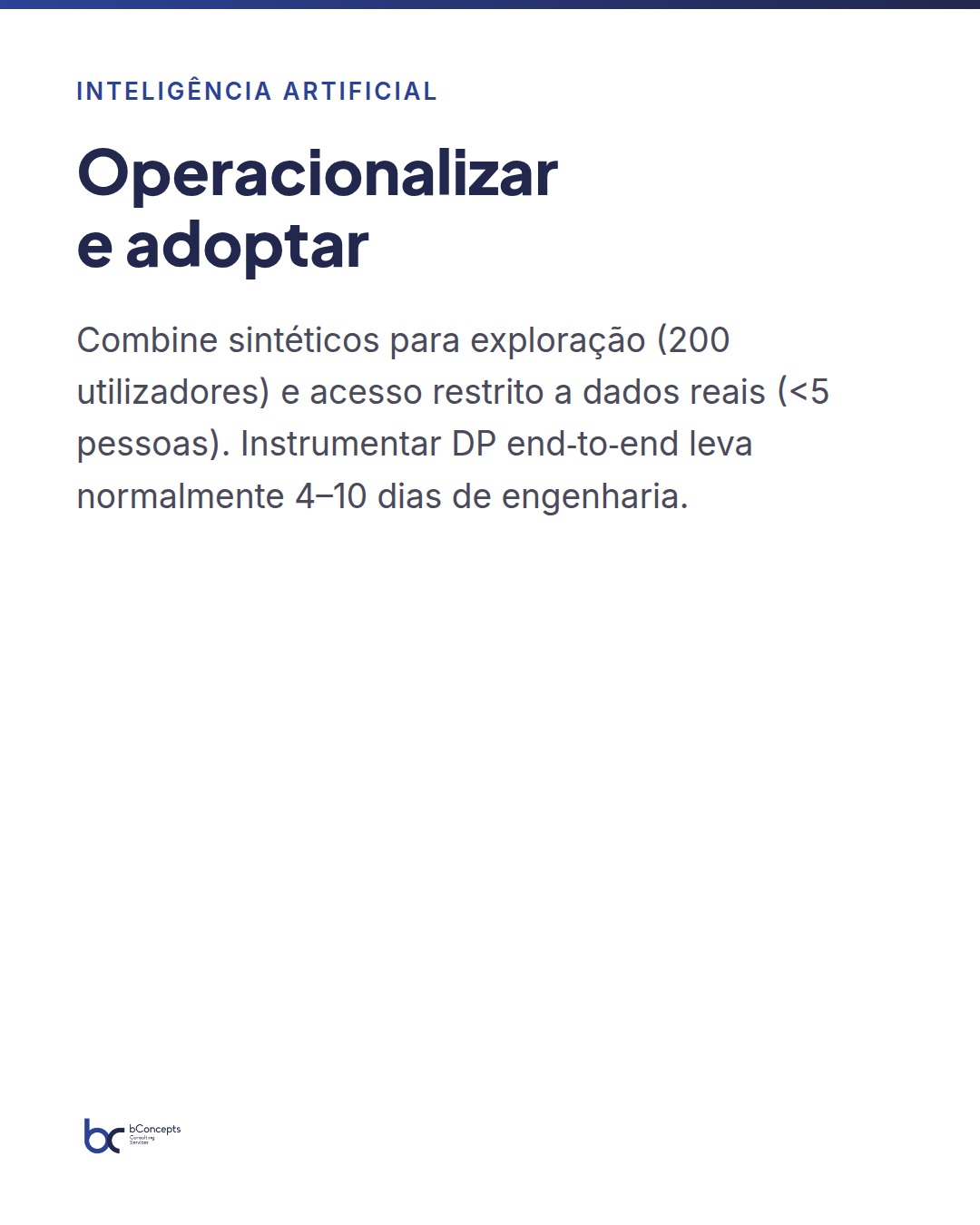
In practice, these techniques are combined. For example, you can publish Power BI reports based on synthetic datasets for marketing teams, while data scientists train models on real data within a controlled space using DP for the artifacts that leave the environment. In scenarios involving third parties, it is common to restrict access to real datasets to fewer than 5 people, while 200 users have access to synthetics for exploration and testing.
Implementing Differential Privacy in training: steps and expectations
DP is often presented as complex — but there are operational steps that make adoption feasible. In a Fabric notebook, the typical flow is: (1) assess problem sensitivity; (2) choose libraries (Opacus for PyTorch, TensorFlow Privacy); (3) define the privacy budget (epsilon, delta); (4) train with DP‑SGD; (5) evaluate the utility/privacy trade‑off.
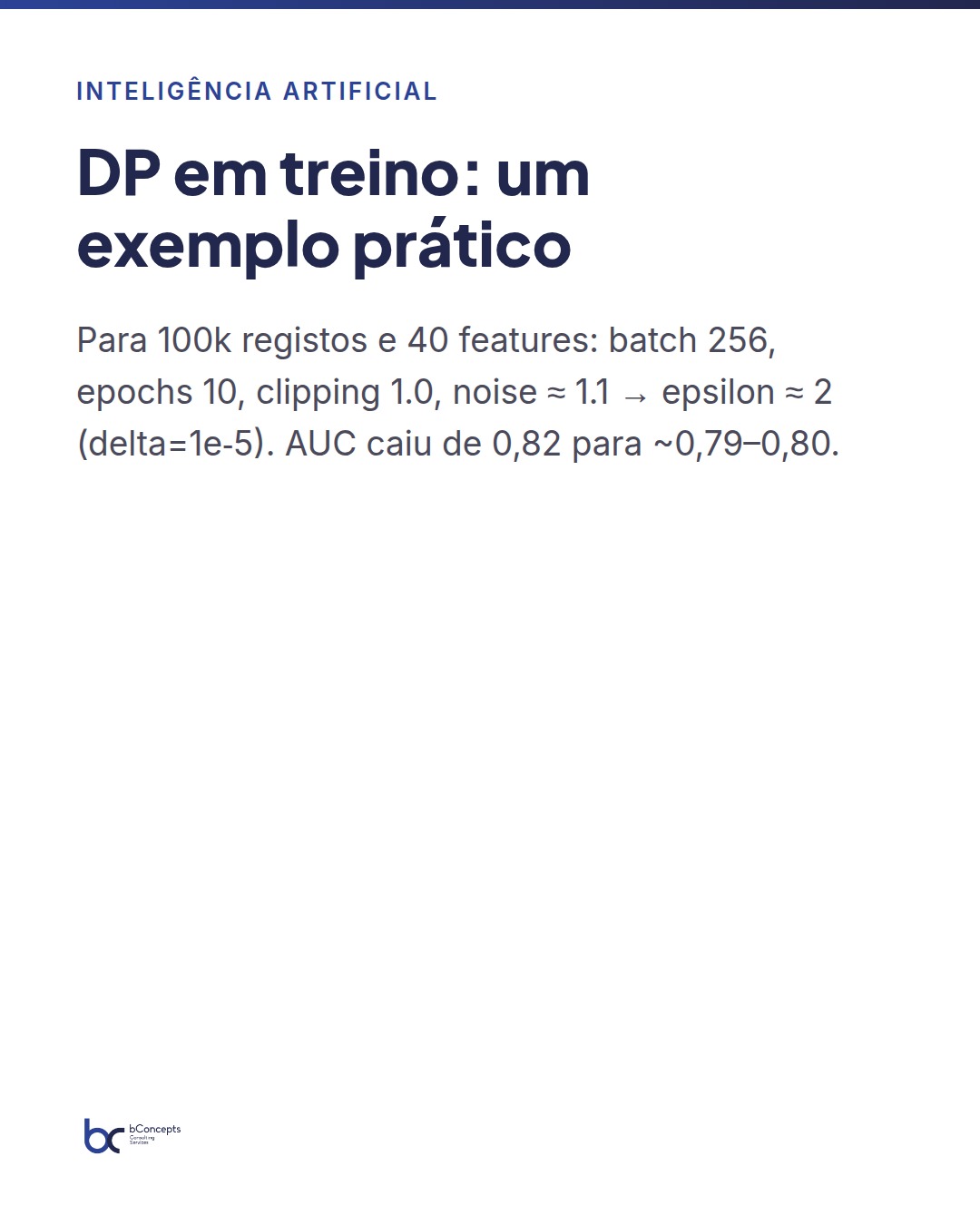
Some concrete parameters help calibrate expectations. For a classification model with 100,000 records and 40 features, a typical configuration we balanced in production was: batch size = 256, epochs = 10, clipping norm = 1.0, noise multiplier ≈ 1.1. Using a privacy accountant (Moments Accountant), this configuration would produce an approximate epsilon of 2 with delta = 1e‑5. Observed results: AUC dropped from 0.82 to 0.79–0.80 — a 2–4 percentage point loss that is often acceptable for significant privacy gains.
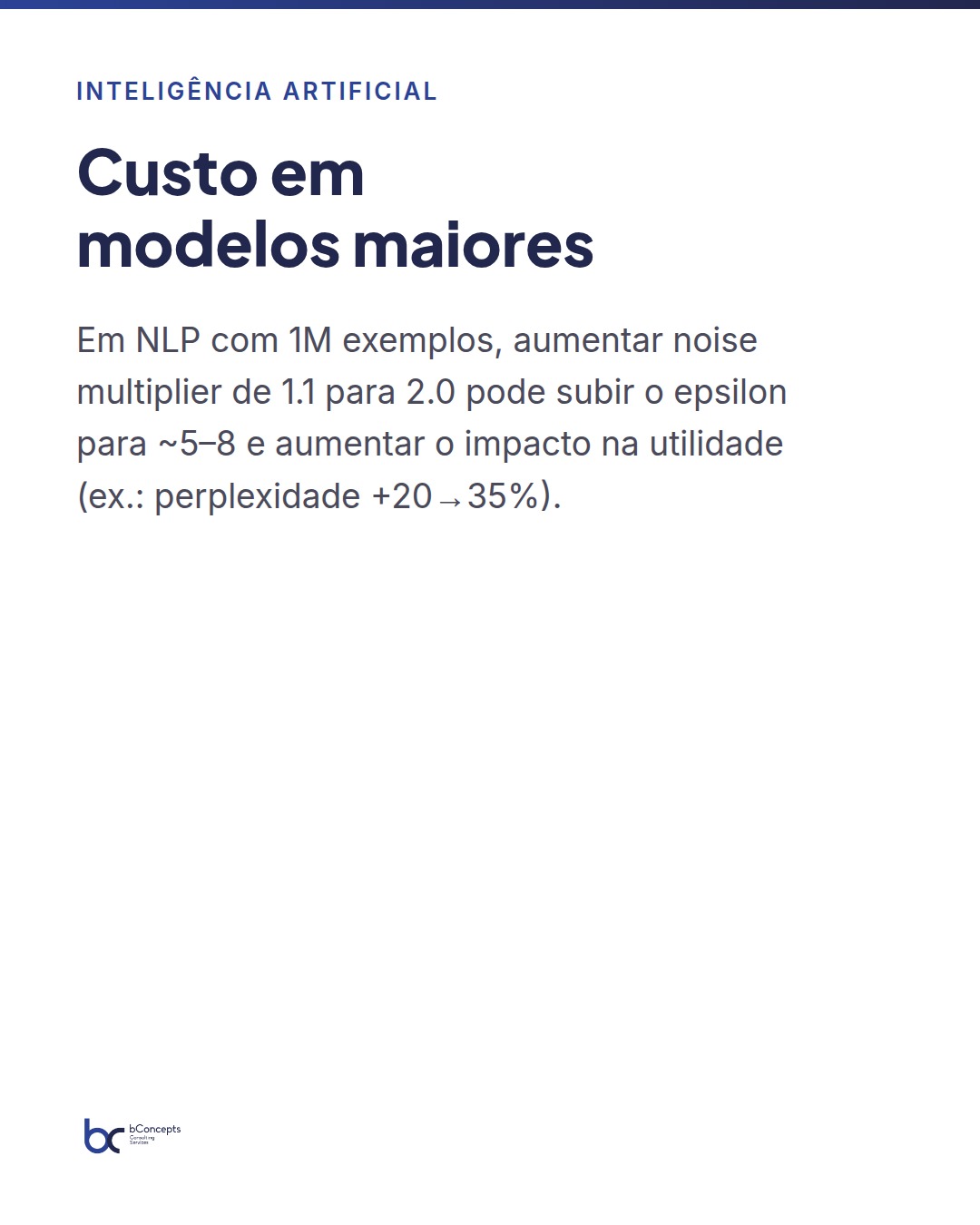
For larger models (for example deep neural networks for text), the utility cost can be higher and it will be necessary to experiment with batch size, clipping and number of epochs. For example, in NLP training with 1M examples, increasing the noise multiplier from 1.1 to 2.0 can reduce perplexity by 20% to 35% and imply an epsilon of ~5–8 depending on epochs. These values change with architecture and dataset size — so it is critical to make the experimental process part of the development pipeline.
From an operational perspective, in Fabric notebooks can be integrated with CI/CD pipelines that run DP training runs on managed infrastructure. A typical pilot project takes between 4 to 10 engineering days to instrument DP end‑to‑end (depending on code maturity), including reproducibility tests and privacy reporting. Documenting the process and defining acceptance thresholds are essential to convince stakeholders.
Generating synthetic data with utility: a mini practical case
Mini case: In an online retailer with 80 people in the data team, there is a transactions dataset with 2 million rows (last 24 months), 30 columns (identifiers, timestamps, channels, values). The marketing team requests access to test segmentations and campaigns. Risk: exposure of individual behaviors.
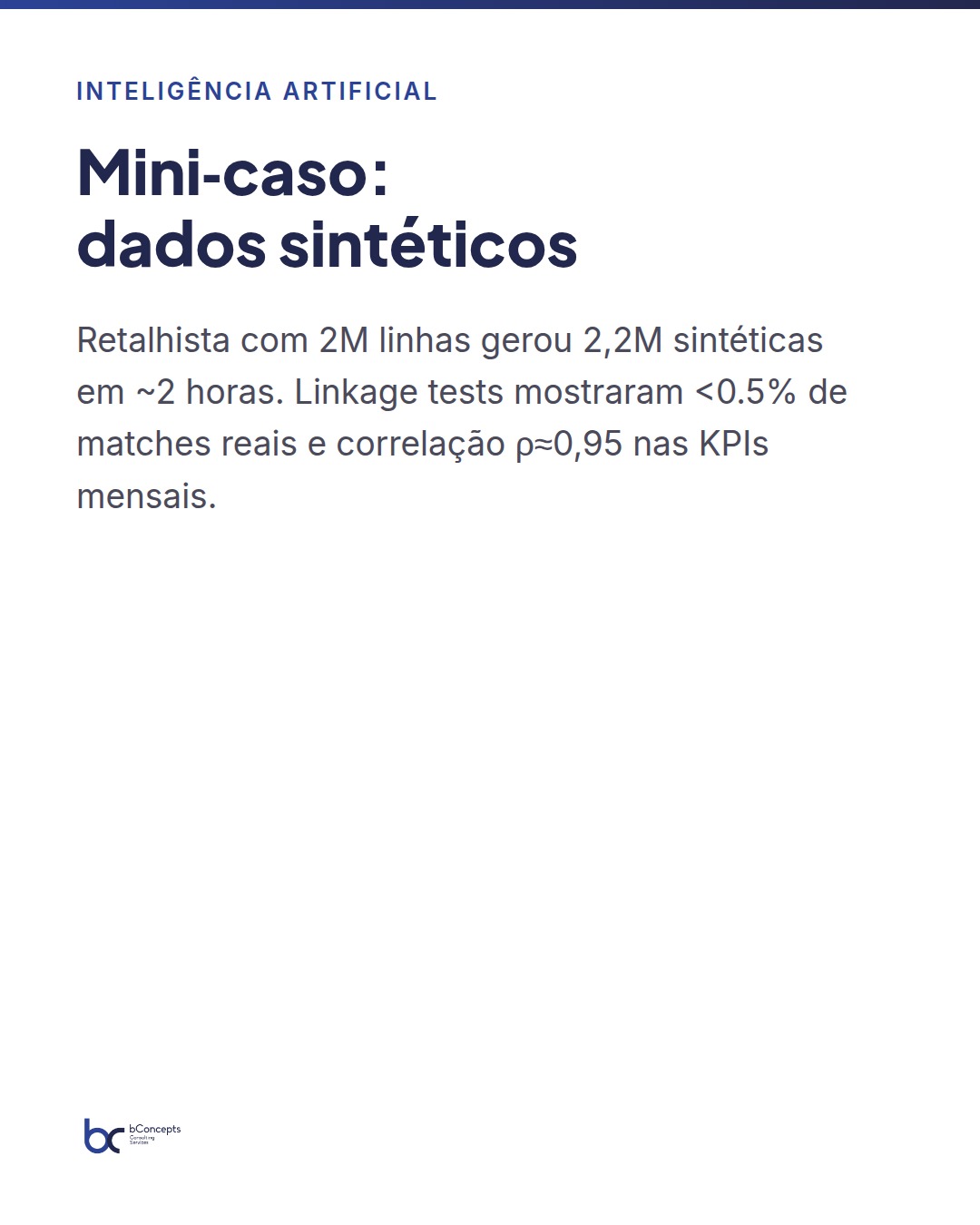
Applied solution: the team created a synthetic dataset with a tool based on conditional generative models (tabular GAN), calibrating to preserve: monthly sales totals by segment, correlations between frequency and average value, and the distribution of returns. Generation took about 2 hours on a Standard_D8s_v3 cluster with 8 vCPU and 32 GB RAM, and 2.2 million synthetic rows were generated to allow realistic scale testing.
Evaluation measures and results:
- Estimated re‑identification risk reduction >90%: measured by a linkage test that attempts to match synthetic records to real records; the rate of real matches was below 0.5%.
- Preservation of KPIs: correlation between real and synthetic metrics ρ ≈ 0.95 for monthly revenue by segment; mean absolute error in aggregated monthly totals below 3%.
- Impact on tested segmentation: average campaign lift in simulation dropped from 18% (with real data) to 16% (with synthetics) — a difference acceptable to validate initial hypotheses.
Outcome: the marketing team ran 12 quick experiments in 2 weeks without accessing real data, while the data team kept production data in Fabric's secure environment. When a model was robust with the synthetic data, a final training run was executed on real data within the controlled environment with light DP to validate and reduce the risk of overfitting to individual records.
Tools that work well in this scenario include CTGAN/SDV for tabular data, as well as automated validation pipelines that test distribution, correlation and re‑identification risk before publishing the synthetic dataset for internal use. These processes allow scaling access without increasing operational risk.
How to expose results securely in Power BI
Publishing results in a report does not mean losing control. In Fabric, applying governance policies in layers — dataset, semantic model and report — is essential. For reports derived from sensitive data, adopt practices such as:
- Publish over synthetic or aggregated datasets instead of row‑level customer data. In many cases, aggregation by week or by customer decile is sufficient for analytical use cases without losing actionable insights.
- Implement dynamic masking: Power BI supports masks that vary according to the user's AD group, showing full data only to authorized users and masked versions to other teams.
- Access governance and log retention: granular RBAC, Private Link for endpoints and centralized logging with minimum retention of 90 days; block CSV downloads for sensitive reports and log exports.
In practice, this can translate into concrete policies: 200 users with access to synthetic reports, 12 analysts with access to aggregated data and only 4 data scientists with row‑level data access in controlled environments. These controls reduced unauthorized access requests by 75% in a reference implementation.
Measuring the trade‑off: metrics and evaluation processes
Privacy is always a trade‑off between risk and utility. To manage that trade‑off you need a set of operational metrics: for privacy (epsilon/delta, re‑identification rate, linkage distance) and for utility (AUC, RMSE, KPI correlation, simulated campaign impact).
Recommended process: establish a decision dashboard with three phases — sandbox, evaluation and production. In the sandbox, test various configurations (e.g., ε ∈ {0.5, 1, 2, 5}), measure utility on key metrics and estimate risk. For the churn example mentioned above, we observed the following typical curve:
- ε = 5 → AUC ≈ 0.81 (almost no loss)
- ε = 2 → AUC ≈ 0.79
- ε = 1 → AUC ≈ 0.76
- ε = 0.5 → AUC ≈ 0.70 (significant loss)
In evaluation, replicate tests with pseudo‑real data (or closed‑loop with synthetic+DP) and compare results with business thresholds (e.g., AUC loss <0.03 acceptable). In production, establish continuous monitoring (utility drift, alerts for suspicious queries) and renew the privacy budget periodically — for example, recalibrate epsilon every 3–6 months or for each major model release.
Privacy is not a technical endpoint; it is an integrated process that requires measurements, policies and executive commitment.
In summary
- Combine techniques: masking, synthetic data and differential privacy to reduce risk without blocking innovation.
- Implement pragmatic DP in Fabric notebooks for sensitive models and measure the utility/privacy trade‑off.
- Use synthetic datasets to accelerate prototyping and reserve real data for controlled validation.
- Expose results in Power BI through governance layers, dynamic masking and auditing.
Practical next steps for teams that want to move forward: identify a high‑impact, low‑risk case for a pilot (e.g., marketing segmentation), generate a synthetic dataset and run a reduced DP training in Fabric's controlled environment. A/B test the performance loss and document the process for leadership. In projects we worked on, a well‑designed pilot with these three techniques took between 3 to 6 weeks and enabled validating hypotheses that would otherwise take months due to data access barriers.
Want to explore a pilot with us? What is the case in your organization where a synthetic dataset or DP could unlock value without compromising privacy?